
The Forever Home
Disclaimer. I have pulled from our own experience and added the experience of several other families in the same position to find a middle of the road answer, but everyone’s claim is different and everyone’s housing needs are different.
The Housing Need
Housing is a recognised head of loss and if the claim warrants it a house is purchased for the child if it’s in their best interest. I know of no cases where this didn’t occur but nothing is ever a certainty when it comes to the law. In most cases it’s for life but a move is possible in exceptional circumstances. The type of house is very dependant on the child’s disability. A wheelchair user’s needs will differ vastly from that of a mildly affected child or one who has behavioural issues from the injury.
During Interim the Housing Expert from both sides will interview you and look at what is needed to give your child as near a ‘normal’ life as possible ‘but for’ the injury. Obviously, this is a ridiculous concept as we all know, but the expert reports outline the child’s needs and how to accommodate them and extends into their life as adults. The reports are not designed to accommodate the rest of the family, but obviously you will be living in the same house so you will be given adequate accommodation. Should parents be divorced but share equal care of the child, in very rare circumstances the case may provide two houses, but the most likely scenario is one house provided by the case (the child’s house) and adaptations to the second parent’s home.
When you help compile the housing need be sure to emphasise what you want for your child, but realise there needs to be evidence to support wherever possible as that strengthens your argument. Think about what you want before the interviews and how you can support your wishes. An example is a hydro pool. Many families with a physically disabled child will appreciate how important hydro therapy is. If you already have a small hot tub, say how many times the child uses it, how they benefit from it (sleep, relaxation, physiotherapy, stretches etc) and how difficult it is to outsource hydrotherapy on a practical level. In our own case scoliosis surgery massively restricts other activities and a high level of disability is another restriction.
If the child has a behavioural disability, they may need a sensory room with surround sound for relaxation and mood regulation. If school has such a room but you currently do not, emphasise the benefit of their own personal sensory space at home. Just because you currently are not able to provide this option, doesn’t mean it’s not desirable.
Housing Costs
Your housing expert should give you a ball park figure on how much to pay for the house. This depends on the area you live in and may be higher in more expensive areas. They also give you (if not ask) an approximate figure for the adaptations. In our case pretty much the same price as the house. Adaptations usually include building on extensions to accommodate ground floor living for the injured person and carers accommodation. Often ground floor living is best for a physically disabled child as it is their house and in theory, they should be able to access all of it. However, this type of house is almost impossible to find so a compromise may be a large lift or the child living in their own annex (bedroom, carers accommodation, wet room, physio room with close access to their hydro pool) and full access to downstairs living with their family, so a large open plan living room, kitchen, games room, hall etc is needed. Family can sleep upstairs and have a good video link to their child if necessary.
As you will be living in your child’s home you would usually be expected to pay a share of the bills but it is case and need specific so that needs to be worked out. Additional heating, water and electricity is normal for a disabled person, so those considerable amounts will come out of the child’s award. There is a fair bit of variability here depending on the family circumstances.
Home Adaptations
It is likely the adaptations will cost the price of the house again, although it differs with each case. For a wheelchair user you will need – widened doors, level threshold, space for easy turning circle, all level floors, significant ground floor space or lift installation, space for transfers, ceiling suitable for ceiling track hoist, (so many barn conversions in our area!) rise and fall bath and sink, changing table, heated overhead dryer, toilets that wash and dry for independence, specialist sensors on doors to allow the user to open doors, change TV channels, open curtains, turn on lights and so on.
Other considerations are: Hydrotherapy pool, Physiotherapy room, ramp if necessary, lots of parking for WAV and carers, Car port if raining attached to house, garden adaptations (raised beds etc), wet room or adapted bathroom, security CCTV, burglar alarms, emergency evacuation provision, storage room (large), office. There are plenty of other considerations particular to each child’s disability.
The child’s area should be with the carers so that your family can still have privacy, with the child able to be with the family when desired. This may be a specially designed extension to accommodate both the child and their needs (bedroom, sitting room (when they are older), wet room, therapy room and may lead out to a hydrotherapy pool) and living space for the carers. If you provide care for your child/young adult think about how this would work for you as a family and plan accordingly.
If your child has no major physical needs but needs a companion/buddy then a games room will be good for privacy and their interaction, likewise for private schooling or ongoing education a learning area with technology built in. All these needs should be explored in the Expert Witness reports and will be discussed at settlement.
Don’t forget the ‘family’ area must include the child, therefore living areas, dining, kitchen etc must be big enough for the child to be with their family, so enlarging and improving them will benefit the child too.
Any architect or building company suggested by the case manager or recommended by the case should be reviewed and reviewed again by yourselves! I cannot stress this enough. I’ve heard so many stories of dodgy builders, useless architects and mounting costs wasted because of failed building works. You really don’t need a ‘specialist’ builder if the work is fairly standard, you just need a good one! Ask on support groups for recommendations. This money comes out of a limited budget for the house and is wasted money if you don’t get it right.
Carers
A need for carers and the number required over a 24 hour period is also something that will be factored into the housing equation. They require a small sleeping area, a sitting area, a kitchenette and a shower room/toilet plus access to an office or work area.
Carers come in several flavours. Sometimes two are needed 24/7, sometimes only one, and sometimes parents provide all care for a number of years. A child with a tracheostomy or epilepsy will need waking night carers, whereas a child who sleeps well could have sleeping carers, who do care only as and when needed. If the child doesn’t need anyone in the room at night, CCTV can be set up with monitors to wake carers and they can be in another room or even upstairs. Carers areas need to be close to the child of course but not in the family’s private area.
Finding the House

Hope

Despair
The case manager can employ a housing expert to find your house. This is very expensive but may be worth it in Interim as the money will come from the defence, but frankly having spoken to many families, they have all found their own house on Rightmove, Zoopla, OnTheMarket, contacting local estate agents with their wish list, and even leafletting houses that fit the bill in case they are deciding to sell. You are a cash buyer but need the approval of the Deputy who has to apply to the court of protection to release a considerable sum of money. They will need an architects approval/survey and the Case manager/OT to ensure it meets the child’s needs. This can take time but buying any house will take months, and the fact we all seem to end up with a forever home means it isn’t impossible. Keep regular contact with the estate agents as they may take you off the books if they don’t hear from you.
Outdoor Space
Fight for a large garden area so that your child can enjoy fresh air and maybe some trees to sit under, as well as such things as a sensory garden, pond and areas for a service dog to run in. Easy level access to the garden and patio is also essential.
Putting your own money into the house
Discuss this with the Deputy as there are pro’s and cons. You can’t transport your own mortgage on to the house, it must be bought outright. The House is usually registered in the child’s name and the deputies if they don’t have a Trust. However how the house is registered depends on the settlement/trust/deputy arrangement. If you put in your own money you would own a percentage.
What happens if the child dies?
This is a difficult subject, but it is something parents quite reasonably worry about, particularly when the family home has been purchased or adapted using the child’s compensation.
If the child dies, the Deputyship comes to an end and the child’s estate has to be dealt with. What happens to the house and the remaining compensation will depend on how the property and settlement have been structured, whether the child had capacity to make a Will, and the particular terms of any trust.
If the child had capacity and made a valid Will, their estate will normally be dealt with according to that Will. If they lacked capacity to make a Will, the position is more complicated and the Court of Protection may need to have been involved in making a statutory Will during their lifetime. The rules of intestacy can also become relevant where there is no valid Will.
Inheritance Tax can be an important consideration. It is not necessarily the case that the family home will have to be sold, but if tax is due and there are insufficient other assets available to pay it, selling or refinancing property may become necessary. The tax position can also be affected by whether the property or compensation is held personally, through a trust, or in another arrangement.
This is therefore something worth discussing with your solicitor, Deputy and a specialist tax adviser when the settlement and housing arrangements are being considered, rather than waiting until something happens. The precise structure can make a significant difference.
I know this is an upsetting subject to think about, but asking the question does not mean that you expect your child to die. It is simply part of making sure that the arrangements made for your child’s future also protect the family as far as possible if circumstances change.
What happens if your child has capacity?
If they can make decisions for themselves, they will most likely have a Trust fund set up at Settlement. Under 18 its managed by the Trustees, which can include parents. Post 18 they can be involved in decisions on their own future. This may include marriage, long term relationships or an alternative lifestyle than with their parents. Either way, if the house is bought for the child and has no input from the parents, the parents have virtually no safeguards against eviction by their child. Obviously, their child is unlikely to evict them, but nevertheless parents in this situation should make provision for their future which doesn’t involve their child’s house.
When to buy
The big question is buy in interim or after settlement? There are pros and cons to both. If you buy in Interim then it’s a done deal and the defence can’t argue you down on size and costs. However your housing award may not be as much as you think and you will have to add more than you intended from other pots or even your own money. If you buy after settlement you do know what you are working with, although it may be less than you thought as mediation is all about the claimant keeping the settlement high and the defence keeping it lower. Interim can take up to 3 years. 3 years of unsatisfactory living in cramped accommodation or rental (possibly multiple rentals) plus the added time to build an extension or put in the adaptations, causes further delay.
If the original house is small it will need a large extension. Often the case will provide a whole wing built for the child including the carers accommodation as listed above. A larger house will possibly need more internal reorganisation, rather than large extensions. Building your own house from scratch is also possible but building land in desirable areas is snapped up by builders as they can put several houses on the land, make big profits and are happy to pay the overinflated price of land with outline planning permission.
If you do see your perfect property in Interim, it may be best to buy then as it may be gone if you wait. Your case manager and team will be able to talk through what’s likely to be agreed although, as they can’t stop mentioning, nothing is guaranteed and you may need to take money from other areas of the claim. Its an awful experience as you are constantly on edge you may make the wrong decision!
Location
Things to consider: Transport links for carers. Quiet road. Flat level plot (one house we looked at looked perfect on paper, but the reality was the garden was so steep and dipped into a valley, the family rigged up a zipwire to the paddock to get hay to the horses!). Near work, schools, family, support network. Ample parking for carers etc. Ongoing adult services post school. Schools for other children. Finding and buying the house in incredibly stressful. Take a break if you can. You will be tearing your hair out at some point, but people eventually do get there.
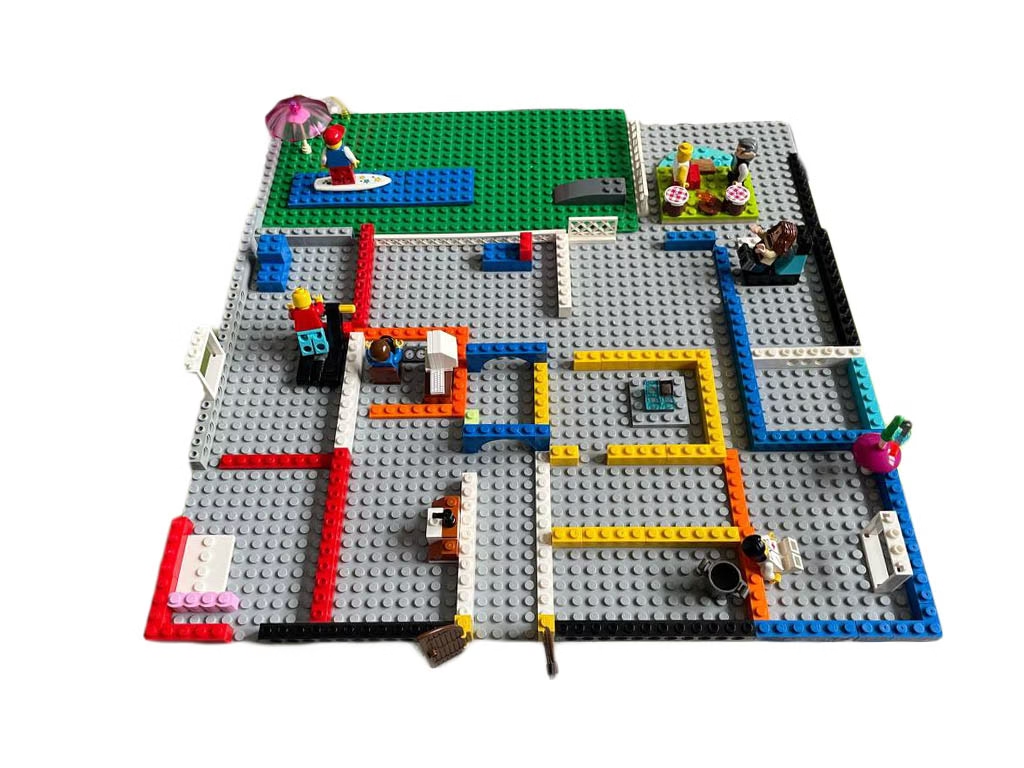
If you’re unsure on a layout, do what we do and spend hours making the ideal floorplan from Lego!
Sources: Judicial College Guidelines, case law, GOV.UK / Court of Protection